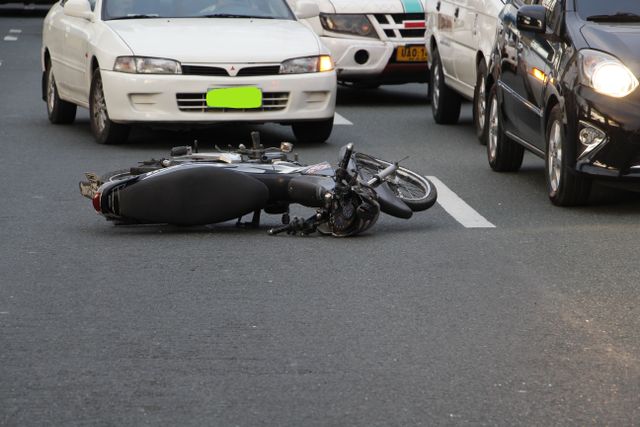
In most cases, the driver who turned left is at fault. Nevada law requires a driver turning left at an intersection to yield to oncoming traffic that is in the intersection or close enough to be an immediate hazard. A motorcycle counts the same as any other vehicle. The rider can still share fault for speed, an illegal pass, or a red light, and that share reduces what the rider recovers.
Nwogbe Law Group represents injured riders in Las Vegas. Its founder, Stephen A. Nwogbe, worked as an insurance defense attorney before he began representing injured people, so this guide also covers how insurers argue these claims.
What Nevada law requires of the turning driver
NRS 484B.253 says the driver of a vehicle within an intersection who intends to turn left shall yield the right-of-way to a vehicle approaching from the opposite direction. The duty applies when that vehicle is within the intersection or so close that it is an immediate hazard. Two more statutes apply:
- NRS 484B.413 allows a turn only when it can be made with reasonable safety. The turn signal must run for at least the last 100 feet in a business or residential district, and the last 300 feet elsewhere.
- NRS 486.341 gives every motorcycle on the highway full use of the traffic lane it occupies.
A violation of these statutes is strong evidence that the driver was negligent. The same yield rule governs left-turn crashes between two cars, which our Las Vegas auto accident lawyer practice handles.
The yield statute has a second half that adjusters rely on. Once the turning driver has yielded and signaled, oncoming drivers must yield to the turn. Expect the driver to say the turn was already underway and the motorcycle was far off when it began.
Why left-turn crashes hit riders so often
NHTSA counted 3,052 fatal two-vehicle crashes involving a motorcycle in 2021. In 43 percent of them, the other vehicle was turning left while the motorcycle was going straight, passing, or overtaking.
Drivers often say they never saw the rider. A motorcycle has a narrow profile, and its distance and speed are hard to judge head-on. The duty to yield does not depend on what the driver noticed.
When the rider can share fault
Speed
A motorcycle well over the limit closes the gap faster than a careful driver would expect, and a jury can assign part of the fault to the rider. Skid length, vehicle damage, and video are used to estimate speed, so the claim should never rest on the driver’s guess. Our post on what happens if the other driver lies about how the accident happened explains how those accounts are tested.
An illegal pass or lane splitting
NRS 486.351 bars riding between vehicles in adjacent lanes, and it bars overtaking another vehicle within the same lane. A rider who was passing a line of stopped cars when the turning driver came through a gap will face a fault argument.
The traffic signal
A rider who entered the intersection on a red light can carry most or all of the fault. Signal timing records and camera footage usually settle this point.
The helmet
NRS 486.231 requires the driver and passenger of a motorcycle to wear protective headgear. A missing helmet did not cause the car to turn, but insurers raise it to contest damages for head injuries.
How shared fault changes the recovery
Under NRS 41.141, an injured person can recover as long as their negligence is not greater than that of the parties they are suing. The award is reduced by the rider’s percentage. A rider found 20 percent at fault recovers 80 percent of the damages. A rider found 50 percent at fault recovers half, and at 51 percent the rider recovers nothing.
For that reason, adjusters work to move a left-turn claim from clear liability to a split. Our article on Nevada’s modified comparative negligence rule goes through the rule in more detail.
Evidence that decides a left-turn claim
Fault in these cases is proved with physical evidence and records. The most useful items are:
- Point of impact. Damage to the front of the motorcycle and the side of the car supports the account of a car crossing the rider’s lane.
- Video from traffic cameras, nearby businesses, and helmet or dash cameras
- Skid marks and the positions where the vehicles came to rest
- Witnesses who saw the signal and the turn
- The police report and any citation issued to the driver
- Data from the car’s event data recorder
Video can be overwritten quickly, so requests to preserve it should go out early. Our post on dash cam footage in a car accident claim covers how footage is used.
Three situations that change the analysis
The driver had a green arrow
A driver turning on a protected green arrow has the right-of-way, and oncoming traffic faces a red light. Fault then depends on proof of who had which signal.
The turn was into a driveway or parking lot
Many of these crashes happen mid-block, where a driver turns left across traffic into a shopping center. The reasonable-safety rule in NRS 484B.413 applies to that turn.
The car never touched the motorcycle
A rider who goes down while braking or swerving to avoid the car can still have a claim against the driver. Proof depends more heavily on witnesses and video, because the car shows no damage.
After a left-turn crash
Get medical care first, and keep the motorcycle and your riding gear in the condition they were in after the crash. Avoid making recorded statements to the other driver’s insurer until you have advice. A motorcycle accident lawyer in Las Vegas can send the preservation requests and deal with the insurer while you treat.
Nevada generally allows two years from the date of the crash to file an injury lawsuit (NRS 11.190(4)(e)).
Frequently asked questions
1) Is the driver turning left always at fault?
No. The turning driver has the duty to yield and is usually found at fault. A rider who was speeding, passing illegally, or running a red light can be assigned part or all of it.
2) The driver says they did not see me. Does that matter?
It is not a defense. The duty to yield applies whether or not the driver noticed the motorcycle. The statement can support your claim because it suggests the driver did not look carefully before turning.
3) Can I still recover if I was speeding?
Possibly. Under NRS 41.141, you can recover if your share of fault is not greater than the driver’s, and the award is reduced by your percentage. How much weight speed carries depends on the evidence.
4) Does riding without a helmet bar my claim?
No. An insurer may argue that a head injury would have been less severe with a helmet. That argument affects damages for those injuries, and the driver remains responsible for the turn.
5) How long do I have to file a claim?
Nevada generally allows two years from the date of the crash for an injury lawsuit. Evidence such as video and witness memory fades much sooner.
Conclusion
The left-turning driver starts with the duty to yield, and the rider’s speed, lane position, and signal decide whether any fault shifts. Physical evidence gathered in the first days usually settles the question.
Consultations with Nwogbe Law Group are free and available 24 hours a day. Call or text 702.508.7243, or schedule a free case evaluation.