You gave the officer a straight account. Days later the adjuster reads you the other driver’s version, and it describes a different crash entirely. Suddenly you are the one who ran the light, drifted the lane, or stopped short for no reason.
Experienced claims handlers expect this. It is unsettling when it happens to you, and far less decisive than it feels in the moment.
Why the other driver’s story changes
Not every conflicting account is a deliberate lie. Memory after a collision is unreliable, and people reconstruct events in ways that favor themselves without consciously deciding to.
Some accounts do change deliberately. A driver who was texting, speeding, or uninsured has an obvious reason to describe events differently. Others shift after speaking with their own insurer and realizing what admitting fault might cost.
For your claim, the motive matters less than what the physical evidence shows. Adjusters and juries resolve conflicting accounts by looking at what the vehicles and the scene say.
It is not your word against theirs
The phrase is common and mostly wrong. A crash leaves physical evidence, and that evidence rarely matches a false account cleanly.
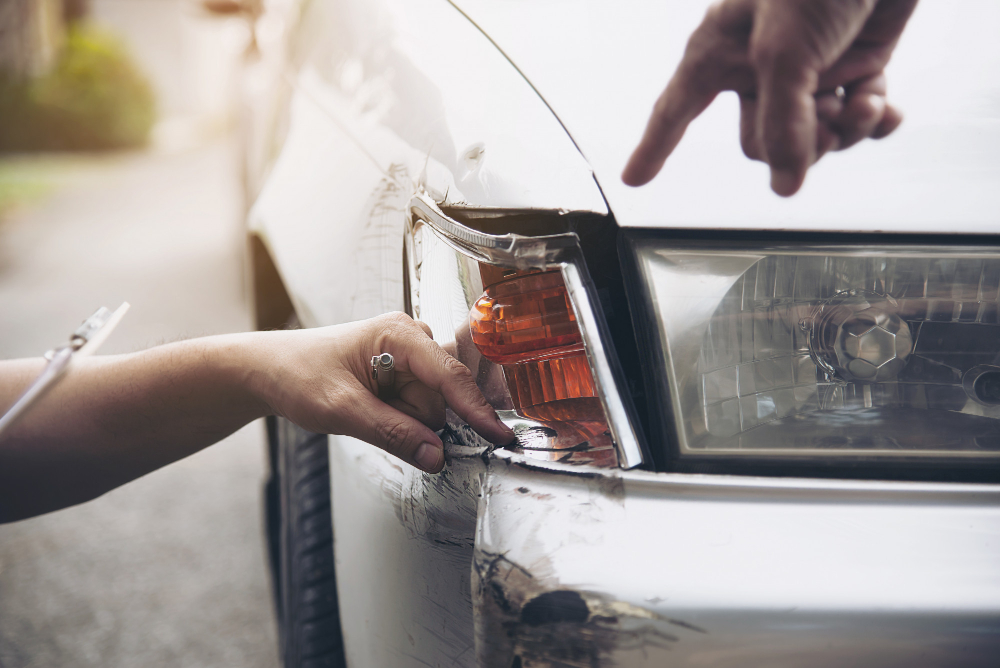
Damage tells a story. Point of impact, angle of crush, height of contact, and the direction the metal folded all indicate how two vehicles met. A driver claiming they were struck from the side while stopped has a problem if the damage shows front-end contact at an angle.
The scene adds more. Skid marks, debris fields, gouges in the pavement, and final rest positions are hard to reconcile with an invented sequence. This is why the steps on our what to do after an accident page matter so much, and why photographing vehicles before they are moved is worth the two minutes it takes.
The evidence that settles disputed liability
When two accounts conflict, these are the sources that usually decide it:
- Photographs of both vehicles in their resting positions, taken before anything is moved.
- The police report, recording the officer’s observations, any citation issued, and each driver’s statement at the scene.
- Independent witnesses, whose contact details are often the single most valuable thing collected at a crash scene.
- Surveillance footage from nearby businesses, traffic cameras, or doorbell cameras, often overwritten within days.
- Dashcam video from either vehicle or from a passing car.
- Event data recorder downloads, which on many vehicles capture speed, braking, throttle, and seat belt use before impact.
- Cell phone records, obtainable in litigation, establishing whether a driver was on a phone at impact.
- 911 audio, which often captures a driver describing the crash before anyone has had time to reconsider.
Commercial vehicles carry the most data. Fleet telematics, electronic logging devices, and maintenance records mean a truck or commercial vehicle claim often has an objective record of speed and hours of service that no statement can override.
Why speed matters more than anything else here
Almost all of that evidence has a shelf life. Surveillance overwrites on a loop, often within a week or two. Vehicles get repaired or sold for salvage, taking the damage evidence with them. Skid marks fade. Witnesses move and stop answering unfamiliar numbers.
A preservation letter sent early can stop a business from recycling footage or an insurer from disposing of a vehicle before it is inspected. That is one of the strongest practical reasons to involve a car accident attorney quickly when the other driver’s account does not match yours.
What a false account is usually trying to accomplish
Most disputed accounts are not attempts to escape blame. They are attempts to move a percentage.
Nevada follows modified comparative negligence under NRS 41.141. An injured person can recover as long as their share of fault is not greater than the combined fault of the parties they are suing, and any award is reduced by their own percentage. Push a claimant from twenty percent at fault to fifty-one percent and the claim is worth nothing at all.
That is why an insurer may argue you were partly responsible even when its own driver caused the crash. Riders see it most. Fault gets assigned against motorcyclists on assumptions about speed and lane position, which is why a motorcycle accident claim often needs evidence work that a routine rear-end case does not.
What to do when you learn their story has changed
- Do not contact the other driver to argue. Nothing good comes of it and the conversation can be used against you.
- Do not change any detail of your own account. Consistency is one of your strongest assets, including the parts you are unsure about.
- Say so plainly when you do not remember something. Honest gaps are more credible than a suspiciously complete account.
- Decline a recorded statement with their insurer until you have legal advice. Those statements exist to find inconsistencies.
- Stay off social media about the crash, your injuries, and your activities.
- Write down everything you remember now, dated, before more time passes.
When a false statement becomes more than a dispute
A knowingly false statement made to obtain or defeat an insurance benefit can amount to insurance fraud under Nevada law, and carriers run their own investigation units because fraudulent claims cost them money.
In practice, proving intent to deceive is difficult, and most cases resolve on evidence of what happened. Suspected fraud can be reported to the Nevada Division of Insurance, though for an injury claim the productive route is usually the evidence itself. Stephen Nwogbe worked as an insurance defense attorney before founding the firm, so the tactics on the other side are familiar ones.
Frequently asked questions
Can I still win if the other driver lies to the police?
Yes. A police report records statements but does not decide liability, and officers frequently arrive after the fact with no independent view of what happened. Physical evidence, video, and witnesses carry more weight than either driver’s account.
What if there were no witnesses and no cameras?
Cases still get proven. Vehicle damage patterns, scene evidence, and event data recorder information often establish the sequence on their own, and an accident reconstruction expert can testify to what the physical evidence shows.
Should I correct my statement if I remember something new?
Tell your attorney first. Genuine additional recollection is normal and can be handled properly. A recorded statement changed without guidance creates an inconsistency the other side will use, even when your correction is honest.
The insurer says I am partly at fault. Is my claim over?
Nevada allows recovery reduced by your percentage of fault, so a disputed liability case is often about negotiating that percentage down rather than about winning or losing outright.
How long do I have to act?
Most Nevada injury claims must be filed within two years of the accident under NRS 11.190, and claims against government entities carry shorter notice requirements. Evidence disappears long before that deadline, so the practical window is far shorter.
Conclusion
A driver telling a different story is frustrating, and it is not the end of your claim. Crashes leave physical records, and those records do not adjust to fit an account given days later. What decides these cases is how quickly someone secures that evidence.
Nwogbe Law Group has represented Las Vegas injury victims since 2016 on a contingency basis, with no fee unless compensation is recovered. Call or text 702.508.7243, or request a free consultation, and bring whatever photos and details you already have.