
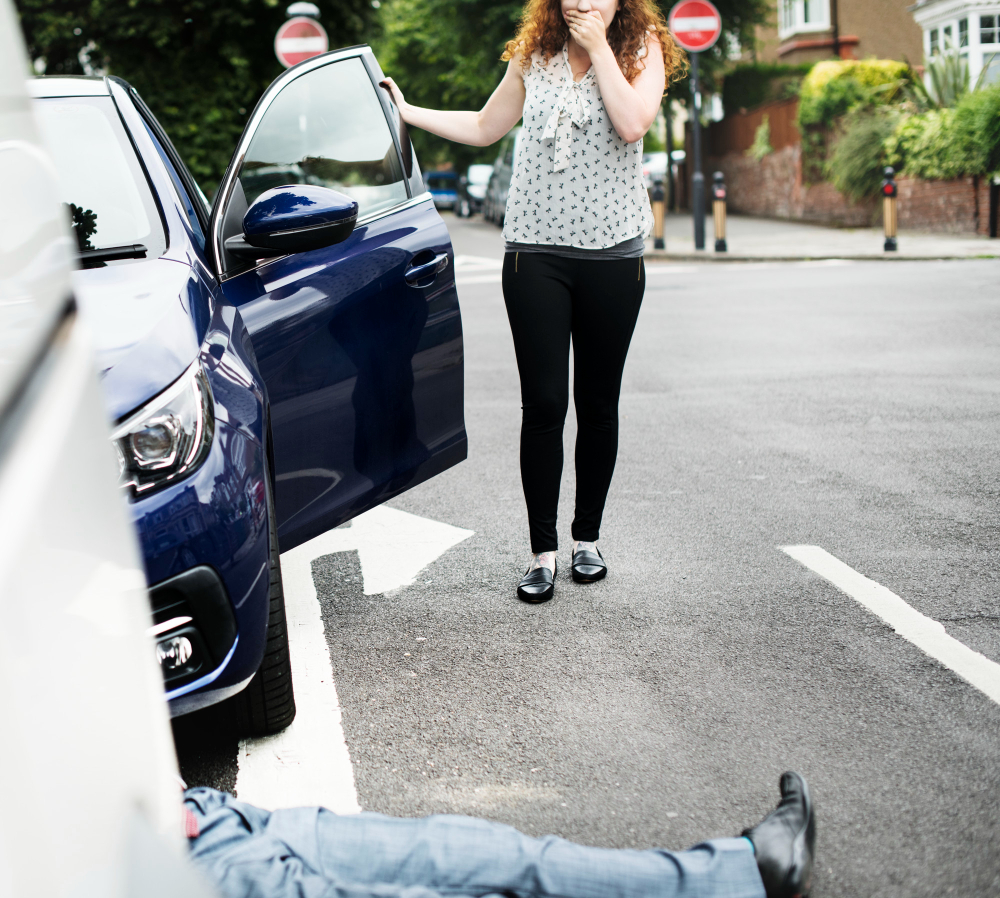
Pedestrian crashes in this valley are not evenly distributed across the map or across the day. They cluster in a handful of situations that repeat, and most of them involve a driver who never saw the person until it was too late.
The patterns are worth knowing whether you walk here daily or are visiting for a weekend. They also matter afterward, because the situation a crash happened in usually shapes how fault gets argued in pedestrian and bicycle accident claims.
The second-lane pass
This is the most common serious pattern on a multi-lane arterial, and it surprises people every time.
A pedestrian starts across. The car in the nearest lane stops. The driver in the next lane over cannot see past that stopped vehicle, does not slow down, and arrives at the crosswalk at full speed exactly when the pedestrian steps out from behind the stopped car.
Nevada addresses this directly. Under NRS 484B.283, when a vehicle is stopped at a marked or unmarked crosswalk, a driver approaching from behind may not overtake and pass that stopped vehicle until the driver has determined it was not stopped to let a pedestrian cross. The law puts the burden on the passing driver, which matters a great deal when an insurer later suggests the pedestrian darted out.
Drivers turning across a crosswalk
The second pattern accounts for a large share of crashes at signalized intersections.
A driver waiting to turn watches for a gap in oncoming traffic, which means looking away from the crosswalk they are about to cross. The pedestrian enters on a walk signal, legally and predictably, from the side the driver is not watching. Right turns on red produce the same geometry, with the driver’s head turned left while the danger approaches from the right.
Unmarked crosswalks are still crosswalks
Paint creates visibility, not legal rights, and both drivers and pedestrians get this wrong.
An intersection has crosswalks whether or not anyone has striped them. Nevada’s yield requirement covers marked and unmarked crosswalks alike, and the rule against passing a stopped vehicle uses the same language. A driver who assumes no paint means no obligation is mistaken, and so is a pedestrian who assumes an unmarked intersection offers no protection.
The countdown timer confuses everyone
Walk signals carry more nuance than most people realize, and the details are in the statute.
While the walking person symbol is showing, pedestrians may cross and drivers of all vehicles must yield. When the upraised hand is flashing alongside a countdown timer, a pedestrian may still begin or continue crossing, but must complete the crossing before the timer runs out.
Two mistakes follow from misreading that. Pedestrians treat a flashing signal as an absolute prohibition and hesitate in the roadway, which is its own hazard. Drivers treat a flashing signal as permission to proceed into a crosswalk someone is still legally occupying. Neither reading matches the law, and both contribute to collisions that could be avoided by anyone who has actually read what to do after an accident and the rules that precede it.
Long blocks and mid-block crossings
Valley arterials place signals far apart, sometimes a quarter mile or more, which shapes behavior.
Someone whose destination sits directly across the street faces a choice between a long walk to a signal and back, or a direct crossing. People choose the direct crossing regularly, and it happens against multiple lanes of traffic moving at forty-five miles per hour or faster.
Nevada law does place duties on pedestrians here. A pedestrian may not suddenly leave a curb and walk into the path of a vehicle so close that the driver cannot yield, and there are conditions under NRS 484B.287 requiring crossing at a crosswalk. A mid-block crossing does not automatically end a claim, though it does change the argument, which is where Nevada’s comparative negligence rule becomes the center of the case.
Darkness, and the parts of the day that matter
Lighting conditions change the risk profile substantially.
A pedestrian in dark clothing on an unlit stretch of arterial is difficult to see until close range, particularly for a driver whose eyes have adjusted to bright commercial lighting a block earlier. Evening commute hours in winter fall after dark, which puts more people on foot in worse visibility.
Alcohol is a factor on both sides of these crashes in a city built around it, and an impaired pedestrian does not excuse an impaired or inattentive driver. Both can be true in the same collision, which is work for a Las Vegas personal injury lawyer rather than an adjuster.
Parking lots, driveways, and valet lanes
Not every pedestrian crash happens on a roadway, and the off-road ones are easy to underestimate.
Resort driveways, valet lanes, garage exits, and shopping center lots put vehicles and people in the same space with no crosswalk, no signal, and frequently no clear right of way. Speeds are lower, which people mistake for safety, but a vehicle backing out of a space has poor visibility and a pedestrian has no protection at any speed.
These cases also raise questions a roadway case does not, including whether the property owner’s design, lighting, or signage played a role. Anyone injured in a car accident claim on private property should expect a more complicated liability picture than a straightforward intersection crash.
Frequently asked questions
1) Does a pedestrian always have the right of way in Nevada?
No. Drivers owe substantial duties, particularly in crosswalks and when turning, but pedestrians have obligations too, including not stepping suddenly into the path of a vehicle that cannot stop.
2) What if I was crossing outside a crosswalk?
It affects the analysis without necessarily ending the claim. Nevada uses a modified comparative negligence system, so a recovery is still possible if your share of fault stays within the statutory limit.
3)The driver says I stepped out from behind a stopped car. Now what?
That is the second-lane pattern, and Nevada law places a specific duty on the passing driver in exactly that situation. The fact that a vehicle was stopped is often the strongest part of the case rather than the weakest.
4) What evidence matters most in a pedestrian case?
Video from nearby businesses, signal timing data, witness accounts, the physical scene, and the vehicle’s damage pattern. Several of those sources overwrite themselves within days, so an early preservation request is worth more than a thorough one late.
5) How long do I have to file in Nevada?
Most injury claims carry a two-year deadline, with shorter notice requirements when a government entity is involved.
Conclusion
The patterns repeat because the conditions that create them repeat: wide arterials, long blocks between signals, turning drivers looking the wrong way, and a city where a great many people walk at night.
At Nwogbe Law Group, Attorney Steve Nwogbe works your file himself instead of handing it to a case manager. The firm serves Las Vegas, North Las Vegas, Henderson, Boulder City, and Summerlin.
Reach us at 702.508.7243 by phone or text, or start a free case evaluation while the footage and the scene still exist.