
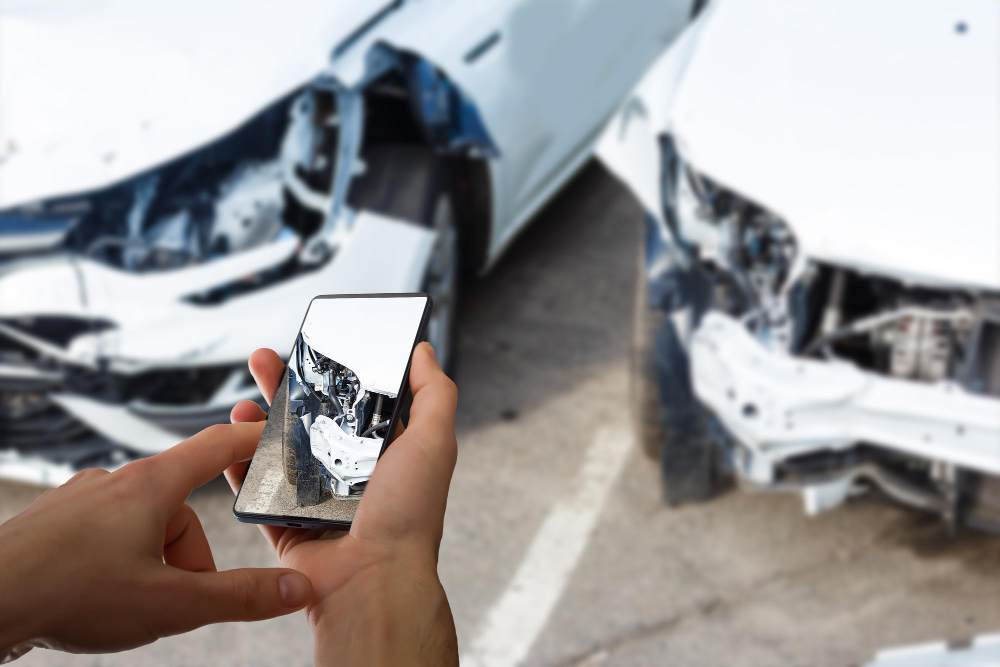
Most people reach for a phone after a crash. Fewer know what to point it at.
The difference surfaces months later, when an adjuster questions where the vehicles were sitting, how much of the intersection you could see, or whether a bruise was as bad as the chart says. By then the scene is gone, and what survives is whatever someone captured in the first twenty minutes.
What a photograph proves that a description cannot
Written accounts describe conclusions. Photographs record geometry.
An image taken before the cars are moved fixes their resting positions against lane lines, a crosswalk, or a signal pole. That settles questions testimony cannot, including who crossed the center line and how far each vehicle traveled into the intersection.
Sightlines are the second piece. A shot from roughly where your eyes were, facing your direction of travel, shows what was visible. An overgrown hedge or a truck parked near the corner is a hard argument to make three months later without an image.
The shots most people skip
Damage photos get taken. Context photos usually do not. The following tend to be missing from a car accident claim file by the time a firm sees it.
- A wide shot from twenty or thirty feet back, showing the scene rather than one bumper
- Traffic signals, stop signs, and lane markings from the approaching driver’s view
- The undamaged sides of the other vehicle, which closes off later arguments about pre-existing damage
- The interior: deployed airbags, a windshield cracked from inside, a shifted child seat, a latched seatbelt
Nevada requires drivers to exchange names, addresses, and registration numbers at the scene, and to produce a license on request, under NRS 484E.030. A photo of those documents beats copying them by hand, which is how claims start life with a misspelled name and a wrong policy number. Our what to do after a crash page covers the rest of that sequence.
Riders have an extra category. Photograph the helmet, jacket, and gloves before anything gets cleaned or thrown out. Abraded gear demonstrates the forces in a motorcycle accident claim better than a written estimate of speed.
Why photos of minor damage can be turned against you
Insurers routinely argue that a low-speed impact could not have produced the injuries claimed, and property damage photos are the exhibit they use to make that case.
A clean shot of a scuffed bumper, taken from six feet back in good light, supports that argument nicely. What goes unphotographed is the part underneath: a crushed absorber, a bent reinforcement bar, a trunk that no longer closes.
Document the damage that is not obvious from the front, then shoot it again at the body shop once the cover comes off. Ask for the teardown images and the estimate supplement. A repair invoice tells a story one exterior shot does not.
Injuries look different on day three
Bruising often deepens and spreads over the days following an impact. Stiffness, swelling, and restricted movement frequently peak well after the emergency room visit, so photos taken at the scene show the least of what happened.
Photograph visible injuries the day of the accident, then at intervals across the next two weeks. Use consistent light, include something for scale, and hold the same angle. Casts, braces, surgical sites, and mobility aids belong in the sequence.
Premises claims turn on how long the hazard sat there
A Nevada business is generally liable for a hazard created by someone other than its staff only if it knew about the condition or should have known. The Nevada Supreme Court addressed that principle in Sprague v. Lucky Stores (1993).
Photographs speak to that question directly. Dirt tracked through the edge of a puddle, a dried ring around a spill, a mat already saturated: each suggests the condition sat there a while. Capture the missing warning cone as carefully as the spill, along with the lighting and your path. Those details decide slip and fall claims more often than the picture of the floor does.
The same logic applies to animals. In a dog bite case, the gate, the latch, and the fence height matter alongside the wound photos.
Your phone can quietly ruin the file
Photographs carry embedded data: when they were taken, often where, and on what device. That can corroborate your arrival time and how long you stayed.
It also disappears easily. Screenshots lose it, some messaging apps strip it on send, and storage optimization may leave only a reduced copy on the handset. Keep the originals and avoid cropping or filtering anything you plan to rely on. Video from a camera mounted in a vehicle follows a separate set of rules, which we cover in our piece on dash cam footage.
What happens when nobody took photos
Plenty of strong claims begin with no scene photos at all. People are hurt, disoriented, or in an ambulance before anything else occurs to them.
Other sources exist. Nearby businesses often run cameras that retain footage for a limited window, so a preservation request sent early matters more than the photos nobody took. Body camera video, 911 audio, data from newer vehicles, and body shop images fill gaps. Most of those sources overwrite themselves, so speed is the common factor.
Frequently asked questions
How many photos should I take after a crash?
More than feels necessary. Storage costs nothing and the scene is not repeatable. Twenty to thirty images covering the vehicles, the roadway, the traffic controls, the documents, and visible injuries is a reasonable target.
Can a store or casino stop me from photographing where I fell?
Staff may ask you to stop, and on private property they can ask you to leave. They generally cannot delete anything from your phone or demand you hand it over. Take what you can, then report the fall so an incident report exists.
I did not take any photos at the scene. Does that end my claim?
No. Scene photos are useful rather than mandatory. Surveillance video, witness accounts, medical records, and vehicle data can all establish what occurred. Several are erased on a schedule, so the claim deserves a prompt look.
Do photos of minor vehicle damage hurt an injury claim?
They can, when the exterior looks better than the damage underneath. That is a reason to document the full repair, not a reason to withhold images. Evidence held back creates a far larger problem than an unflattering photo.
Can I photograph my injuries weeks after the accident?
Yes, and it is worth doing. Marks that take time to fade, surgical scars, and limited movement recorded over weeks show the course of an injury in a way one early photo cannot. Date the sequence.
Conclusion
A camera is the only investigative tool most people carry at the moment it counts. Ten minutes of ordinary phone photos, taken before anything is moved or cleaned, can answer questions that otherwise take months to argue about.
Stephen Nwogbe spent his early career on the defense side of insurance claims before he began representing injured people in Las Vegas, and that background shapes how this firm reads an evidence file. If photographs exist, bring them. If not, there are other places to look. Call or text 702.508.7243 or request a free case review.